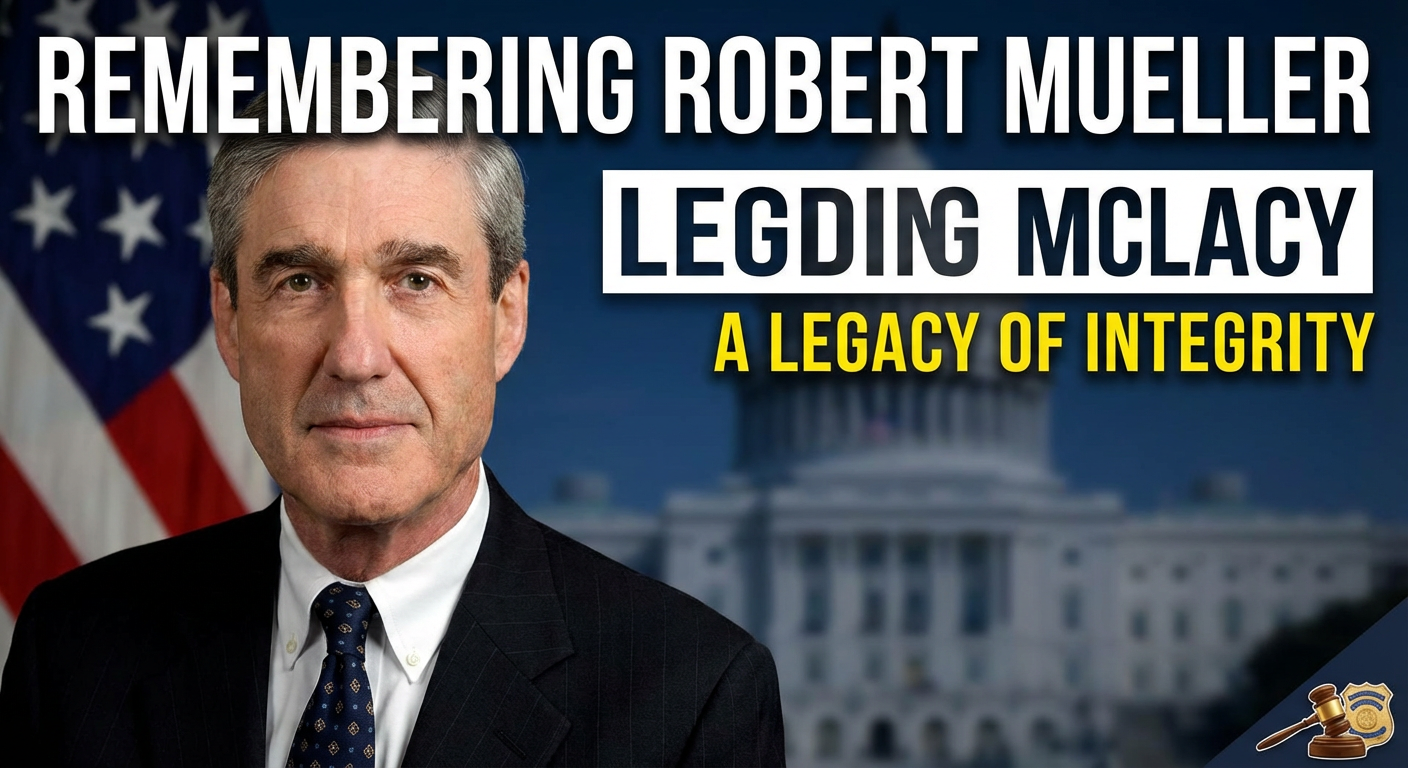
The death of Robert Mueller in March 2026 marked the passing of one of the most influential and respected figures in modern American law enforcement and public service. At the age of 81, Mueller’s death closed a chapter on a career defined by discipline, integrity, and a deep commitment to the rule of law. Known widely for his role as Director of the Federal Bureau of Investigation and later as Special Counsel in one of the most politically sensitive investigations in U.S. history, Mueller leaves behind a legacy that continues to shape legal institutions, political discourse, and public trust in justice systems.
Robert Swan Mueller III was born on August 7, 1944, in New York City. His early life was marked by academic excellence and a strong sense of duty. He attended Princeton University, where he developed both intellectual rigor and leadership qualities. Later, he earned advanced degrees in international relations and law, preparing himself for a career that would eventually place him at the center of national security and justice. Before entering high-level government service, Mueller served in the United States Marine Corps during the Vietnam War, where he was awarded several honors for bravery, including the Bronze Star and Purple Heart.
Mueller’s rise within the U.S. legal system was steady and marked by professionalism and a reputation for fairness. Over the years, he held several important roles within the Department of Justice, gaining experience in criminal prosecution, national security matters, and complex investigations. His approach was often described as methodical, cautious, and deeply rooted in legal principles rather than political influence. These qualities would later define his leadership style and earn him bipartisan respect in an increasingly polarized political environment.
Robert Mueller became Director of the FBI in September 2001, just days before the September 11 terrorist attacks. This timing placed him immediately at the forefront of one of the most significant crises in U.S. history. Under his leadership, the FBI underwent a major transformation. The agency shifted its primary focus from traditional crime-solving to counterterrorism and intelligence gathering, adapting to a rapidly changing global threat environment. Mueller’s tenure, which lasted 12 years, became one of the longest in FBI history and is widely credited with modernizing the agency for the challenges of the 21st century.
After stepping down from the FBI in 2013, Mueller initially returned to private life. However, his public service was not yet over. In 2017, he was appointed as Special Counsel to investigate Russian interference in the 2016 United States presidential election. This investigation, often referred to as the Mueller investigation, examined potential links between Russian actors and members of the Trump campaign. The probe resulted in multiple indictments and brought significant attention to issues of election security and foreign influence. While Mueller’s final report did not establish a criminal conspiracy between the campaign and Russia, it documented extensive interference efforts and left open questions regarding obstruction of justice.
Mueller’s handling of the investigation was widely debated. Supporters praised his independence, restraint, and commitment to facts, while critics argued that the investigation was either too aggressive or not decisive enough. Despite these differing opinions, Mueller maintained a consistent public demeanor, avoiding political commentary and allowing official findings to speak for themselves. This approach reinforced his image as a principled public servant who prioritized institutional integrity over personal recognition.
In his later years, Robert Mueller largely withdrew from public life. In 2025, his family revealed that he had been diagnosed with Parkinson’s disease in 2021, a condition that gradually affected his speech and mobility. Despite these health challenges, Mueller remained a respected figure, and his earlier contributions continued to influence legal and political discussions.
Robert Mueller passed away on March 20, 2026. His family confirmed his death and requested privacy during their time of mourning. His passing prompted widespread reactions from political leaders, legal professionals, and citizens across the United States and around the world. Former presidents, officials, and colleagues paid tribute to his decades of service, highlighting his integrity, dedication, and quiet leadership style. Many emphasized his role in strengthening institutions and maintaining public trust during times of uncertainty.
At the same time, Mueller’s death also reignited political tensions in some circles, reflecting the controversial nature of his work as Special Counsel. Reactions varied widely, illustrating how deeply his investigation had impacted American political life. Despite these divisions, there was broad agreement on his professionalism and commitment to duty, even among those who disagreed with the outcomes of his investigations.
From a historical perspective, Robert Mueller’s legacy is multifaceted. As FBI Director, he guided the agency through a transformative era, redefining its mission in response to new global threats. As Special Counsel, he led one of the most scrutinized investigations in American history, contributing to ongoing debates about election security, executive power, and accountability. Beyond specific roles, his career represents a model of public service grounded in discipline, integrity, and respect for legal processes.
Mueller’s influence extends beyond institutions to the broader concept of justice in a democratic society. He consistently emphasized the importance of facts, evidence, and due process, principles that remain essential for maintaining public confidence in legal systems. In an era marked by rapid information flow and political polarization, his steady and measured approach serves as a reminder of the value of professionalism and restraint.
The death of Robert Mueller represents the loss of a significant figure in American public life. His contributions to law enforcement, national security, and legal integrity will continue to be studied and remembered for years to come. While opinions about his work may differ, his commitment to serving the country with honesty and dedication remains a defining aspect of his legacy. As the United States continues to navigate complex legal and political challenges, the principles embodied by Mueller’s career remain as relevant as ever.