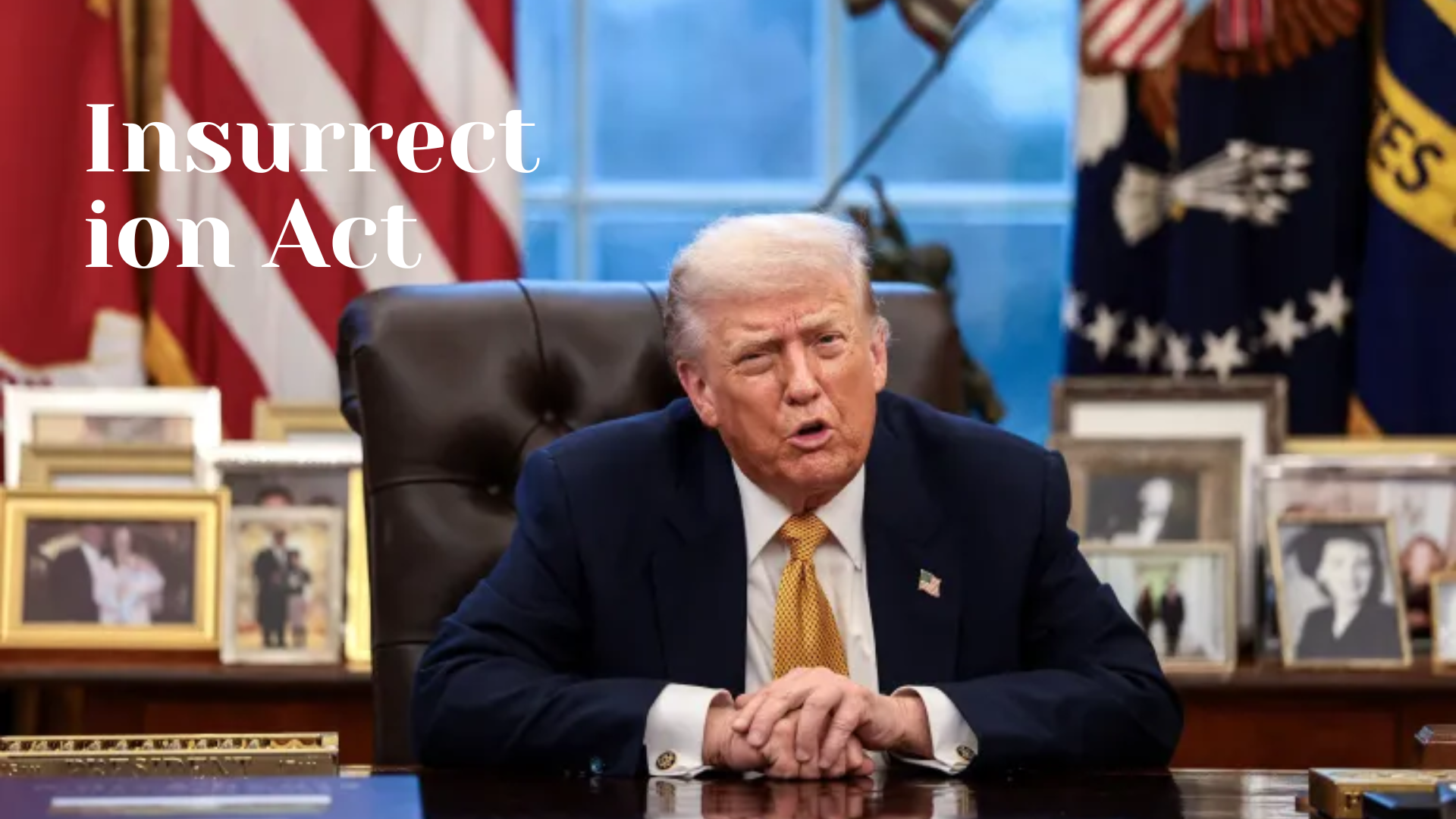
The Insurrection Act stands as one of the most consequential and controversial laws in American governance. It grants the president the authority, under specific circumstances, to deploy federal troops or the National Guard within the United States to restore order. While rarely invoked, the mere existence of this power has long sparked debate among lawmakers, legal scholars, civil rights advocates, and the public. Supporters see it as a necessary last-resort tool to preserve constitutional order, while critics warn of its potential to undermine civil liberties if misused.
At its core, the Insurrection Act is about balance. It sits at the intersection of federal authority and state sovereignty, public safety and personal freedom, executive power and democratic restraint. Understanding why it exists, how it has been used, and why it remains so sensitive requires looking beyond headlines and into the historical and legal framework that shaped it.
The law dates back to the early years of the United States. First enacted in 1807, the Insurrection Act was designed for a young nation still finding its footing. The federal government needed a mechanism to respond when states were unable or unwilling to enforce federal law or suppress violent uprisings. At a time when communication was slow and regional loyalties were strong, the act served as a safeguard against disorder threatening the survival of the union.
Over time, the act evolved through amendments and reinterpretations, but its central purpose remained intact. It allows the president to deploy military forces domestically in three broad situations: when a state requests assistance, when federal law cannot be enforced through normal means, or when constitutional rights are being systematically denied and state authorities fail to act. Each of these conditions carries significant legal weight, which is why the act is considered extraordinary rather than routine.
Historically, presidents have invoked the Insurrection Act sparingly. One of the most notable periods of use came during the civil rights era. Federal troops were deployed to enforce desegregation orders in Southern states where local authorities resisted court rulings. In those moments, the act was framed as a tool to protect constitutional rights when state governments openly defied federal law.
The use of troops in Little Rock, Arkansas, to ensure the integration of public schools remains one of the most cited examples. In that context, the Insurrection Act was seen by many as a moral necessity, reinforcing the idea that federal power could be used to uphold civil rights when states refused to do so. Yet even then, the decision was not without controversy, highlighting how deeply political and emotional such actions can be.
In more recent decades, discussions around the Insurrection Act have intensified during moments of national unrest. Large-scale protests, riots following incidents of police violence, and fears of widespread disorder have all brought the act back into public conversation. Often, the debate arises not because the act is invoked, but because it is threatened or publicly considered.
For critics, the concern is not theoretical. They argue that deploying active-duty military forces on American streets risks blurring the line between civilian law enforcement and military authority. The United States has a long tradition of keeping these roles separate, rooted in the belief that soldiers are trained for combat, not policing communities. The Insurrection Act, in their view, opens the door to misuse if not tightly constrained.
Supporters counter that the act already contains built-in limitations. It does not grant unlimited power, they argue, but rather provides a legal framework for extreme situations when normal governance breaks down. In cases of widespread violence, insurrection, or the collapse of state authority, the federal government has a responsibility to protect lives and preserve constitutional order.
Another layer of complexity lies in how broadly the law is written. The Insurrection Act gives the president significant discretion in determining when its conditions are met. While courts can review actions after the fact, there is limited real-time oversight. This concentration of authority in the executive branch is precisely what alarms civil liberties groups, who fear that political considerations could influence decisions meant to be purely about public safety.
Calls for reform have surfaced periodically, especially after moments of heightened tension. Some lawmakers have proposed narrowing the language of the act, adding clearer definitions, or requiring greater consultation with Congress before troops can be deployed domestically. Others warn that too many restrictions could render the law ineffective in a genuine emergency.
Public perception of the Insurrection Act is heavily shaped by context. When people feel threatened by violence or chaos, there is often greater acceptance of strong federal intervention. When protests are framed as expressions of democratic dissent, the idea of military involvement can feel deeply unsettling. The same law can appear either protective or oppressive depending on how and why it is used.
Legal scholars often point out that the Insurrection Act reflects the tensions inherent in federalism itself. The United States is neither a loose confederation nor a fully centralized state. Power is shared, negotiated, and sometimes contested. The act exists because there are rare moments when that balance fails, and a higher authority is called upon to intervene.
As national conversations around democracy, protest, and executive power continue, the Insurrection Act is unlikely to fade from relevance. Even when it is not invoked, its presence shapes how leaders respond to crises and how citizens interpret those responses. It serves as both a legal instrument and a symbolic reminder of the extraordinary measures available in times of extreme stress.
Ultimately, the debate over the Insurrection Act is less about the text of the law and more about trust. Trust in leaders to act responsibly, trust in institutions to provide checks and balances, and trust in the public to distinguish between necessary action and overreach. As long as that trust remains contested, the Insurrection Act will continue to be scrutinized, debated, and, at times, feared.
What remains clear is that the Insurrection Act is not a relic of the past, nor is it a routine tool of governance. It is a powerful legal option reserved for moments when the ordinary mechanisms of law and order fail. How it is understood and, if ever, applied in the future will say much about the state of American democracy and the values it seeks to uphold.