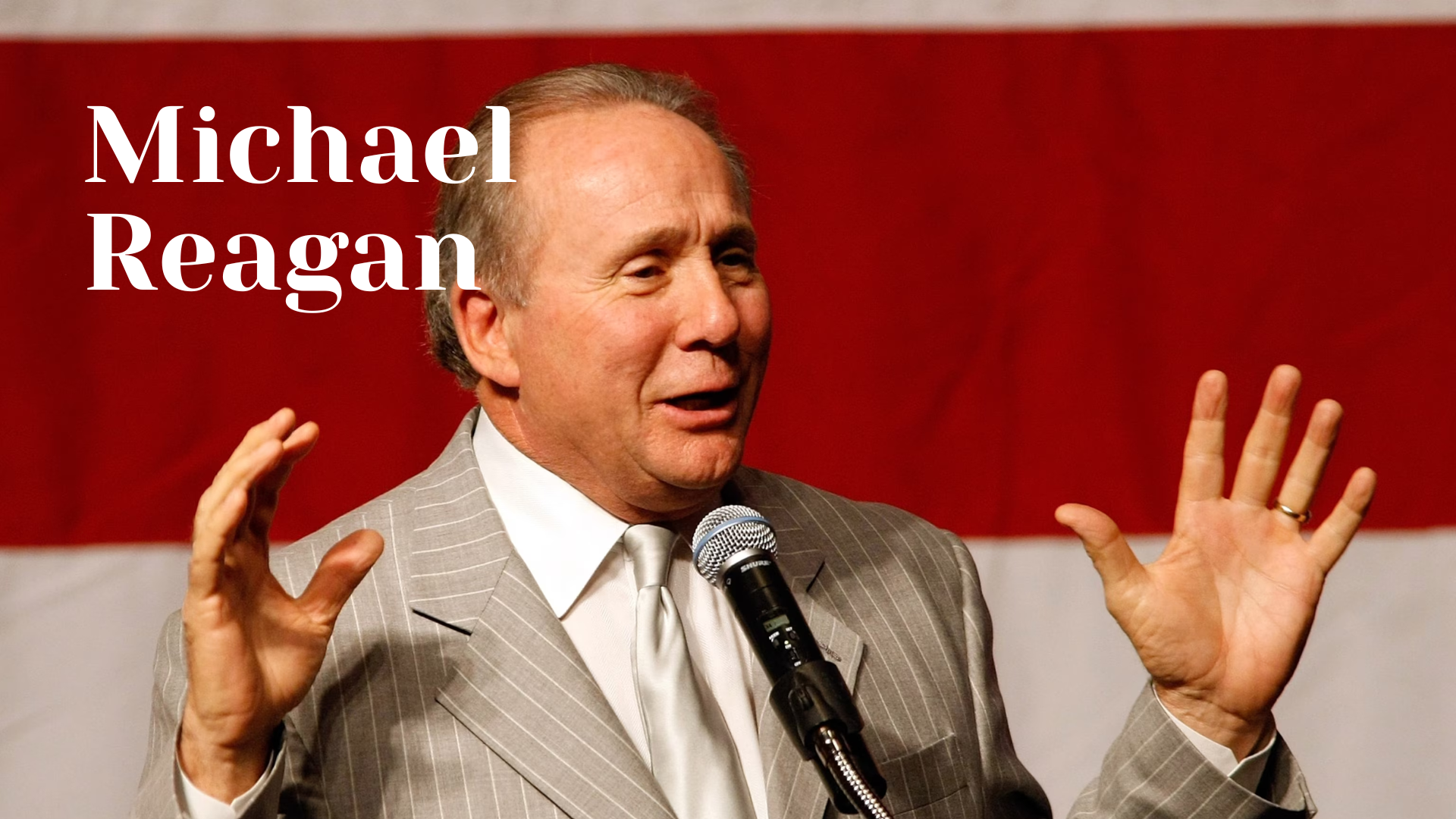
Michael Reagan, the eldest son of former U.S. President Ronald Reagan and actress Jane Wyman, died on January 4, 2026, at the age of 80. His death, announced in early January by the Ronald Reagan Presidential Foundation and Institute, marked the end of a long life shaped by public engagement, personal reflection and a deep connection to his father’s legacy. He passed away surrounded by family in Los Angeles, where he lived much of his adult life.
Born March 18, 1945, in Los Angeles, Michael Reagan came into the world as John Charles Flaugher. He was adopted just hours after birth by Ronald Reagan and Jane Wyman, then a prominent Hollywood couple. This began a lifelong connection to a family destined for public attention, though Michael’s path was distinct from his father’s rise from actor to California governor to the presidency of the United States.
Raised during his adoptive father’s early political and acting career, Michael experienced a childhood both privileged and complicated. He later learned that he had been born to unmarried parents and that adoption shaped his early sense of identity. These themes would surface in his writing decades later, as he reflected openly on adoption, personal struggles and the process of coming to terms with his past.
Michael Reagan attended Arizona State University and later Los Angeles Valley College, though he did not earn a traditional degree. In his younger years he tried his hand in entertainment, making occasional acting appearances in television programs and even working alongside his mother in certain roles. He gained early experience in media and entertainment, which laid the groundwork for his later career in broadcasting and commentary.
In the late 20th century, Michael Reagan transitioned into media work that blended personal perspective with political commentary. He became widely known as the host of The Michael Reagan Show, a nationally syndicated talk radio program that ran for many years and built a dedicated audience. On the air, he offered conservative commentary on current events, politics and cultural issues. His viewpoints drew both support and criticism, reflective of the polarized nature of public discourse in the United States, yet he remained a recognizable presence on the talk radio circuit for nearly two decades.
Beyond radio, Michael contributed regularly as a commentator to conservative television networks and publications. His work often emphasized Republican principles, traditional values and reflections on American political life. He also stood as a vocal proponent of many ideas associated with his father’s political legacy, using speaking engagements and media platforms to explore those themes with audiences across the country.
Michael Reagan also authored several books over his lifetime, including autobiographical works that explored his personal journey. Titles such as On the Outside Looking In and Twice Adopted traced aspects of his life, from adoption and identity to his evolving understanding of faith and family. Another book, Lessons My Father Taught Me, focused on memories, values and life lessons gleaned from his relationship with Ronald Reagan. These works offered readers an intimate glimpse into his life, with both candid reflection and an emphasis on the influence of his father’s ideals.
In addition to his media and writing career, Michael Reagan played an active role in organizations aimed at preserving and promoting his father’s legacy. He served in leadership positions at the Reagan Legacy Foundation, an organization dedicated to advancing the principles and accomplishments of Ronald Reagan’s presidency. Through this work, he helped maintain public memory of Reagan’s political impact, particularly among newer generations of Americans interested in 20th‑century history and conservative thought.
Charitable work was also a consistent thread throughout Michael Reagan’s life. He engaged with a range of nonprofit and advocacy organizations, serving on boards and supporting initiatives focused on children, health issues and adoption communities. Among these efforts were service on advisory boards for adoption and foster care support organizations, along with leadership roles in foundations dedicated to issues such as Alzheimer’s research — a cause personally meaningful to him after his father’s struggle with the disease. He also used activities such as powerboat racing to raise funds for juvenile diabetes, cystic fibrosis research and other charitable causes, demonstrating a commitment to philanthropy that extended beyond his public persona.
Michael Reagan’s personal life was rooted in family. He married his second wife, Colleen, in 1975, and the couple remained together for more than five decades. They had two children, Cameron and Ashley, both of whom pursued their own careers while often reflecting publicly on their father’s influence and legacy. Family was central to Michael’s life, and in public statements following his death, loved ones emphasized his roles as a devoted husband, father and grandfather.
Despite his connection to one of the most famous presidents in modern American history, Michael Reagan carved out a distinct trajectory. His work as a conservative commentator, author and foundation leader kept him in the public eye for decades. He was a figure who often invoked his father’s ideals while articulating his own perspective on contemporary politics and culture. At the same time, he remained candid about his personal history, including the challenges and complexities of growing up in a high‑profile family and reconciling that experience with his own identity.
His passing underscores the changing of a generation. As one of Ronald Reagan’s surviving children, Michael was among the last direct living links to a presidency that shaped American political life in the closing decades of the 20th century. In honoring his life, the Ronald Reagan Presidential Foundation and Institute described him as “a steadfast guardian of his father’s legacy,” a phrase that captures both his public work and personal devotion to the family name.
While the cause of his death was not immediately disclosed, the impact of his work — from media to memoirs to philanthropy — will remain part of discussions about Reagan family history and American political commentary. His life, marked by both public engagement and private reflection, spanned a tumultuous period in American culture and politics. He leaves behind a body of work and a family who mourns his loss, celebrating a life lived in pursuit of personal convictions and a deep commitment to memory, service and legacy.